
You’ve likely heard plenty about India’s major trade deals with the United States and the European Union. The agreement with the European Union was dubbed the “mother of all deals,” and negotiations with the United States were also hailed as a “great deal.” But the real game is yet to come.
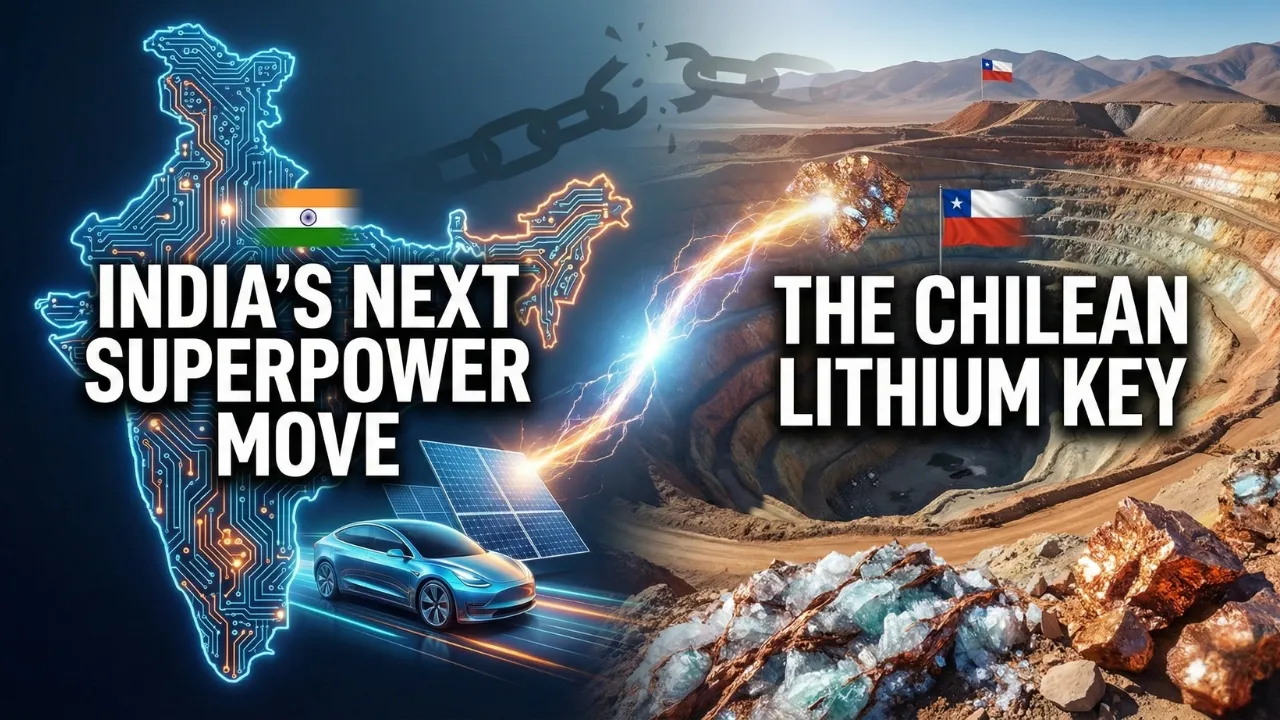
In fact, the Modi government is now preparing for another major step that could lay a strong foundation for India’s next superpower. This country is Chile. India’s Free Trade Agreement (FTA) with this South American country is rapidly taking shape. It is believed that finalising this agreement will significantly boost India’s manufacturing capabilities.
Preparing to Break China’s Monopoly
In today’s changing global economy, if a country wants to progress, it needs resources, not just money. These resources are no longer just simple industrial inputs but have become a “strategic asset.” We’re talking about critical minerals, including lithium, copper, cobalt, rhenium, and molybdenum.
Whether in electronics, electric vehicles (EVs), renewable energy systems, or advanced manufacturing, these minerals serve as oxygen for these technologies. Ironically, China currently holds almost complete control over the supply chain for these minerals.
China has, on numerous occasions, used this dominance as a weapon and attempted to disrupt the supply lines of many countries, including India. Consequently, it became necessary for India to end its dependence on China. This agreement between India and Chile is considered a major, concrete step in this direction.
Chile has a vast wealth of minerals.
Chile is no ordinary trading partner but a global powerhouse in critical minerals. Most importantly, Chile has vast lithium reserves. Lithium is the very element that drives today’s modern world. Everything from your phone’s battery to electric cars and large energy storage systems depends on lithium.
Not just lithium, Chile is the world’s largest producer of copper. Nearly 23 per cent of the world’s copper comes from its own mines. Furthermore, Chile ranks second in lithium production after Australia, accounting for 20 per cent of global lithium demand. It also possesses abundant rhenium, molybdenum, and cobalt. Uninterrupted supplies of these minerals are crucial to India’s “Make in India” campaign and its clean energy goals.
Not just trade, now a new era of partnership
India and Chile’s relationship isn’t just beginning today. A Preferential Trade Agreement was signed between the two countries in 2006, laying the foundation for the current relationship. However, the scope of the ongoing negotiations is much broader. Now, the discussion isn’t just about reducing taxes on certain goods, but discussions on a Comprehensive Economic Partnership Agreement (CEPA) are in the final stages.
This new agreement includes direct cooperation in trade, digital services, investment promotion, and, most importantly, critical minerals. Commerce and Industry Minister Piyush Goyal has also indicated that this free trade agreement could be finalised soon.
Looking at the figures, while India’s exports to Chile declined slightly to $1.15 billion in the 2024-25 fiscal year, India’s imports from Chile increased by 72 per cent to $2.60 billion. This figure clearly demonstrates the significant demand for Chilean raw materials in the Indian industry.
Private companies have also geared up.
Alongside the government, India’s private sector is keen to seize this opportunity. Indian companies are now establishing a direct presence in Chile. Recently, Coal India’s board approved the formation of a holding company in Chile to explore opportunities for critical minerals.
The Adani Group has also taken a major step in this direction. In November last year, a significant agreement was signed between the Adani Group and Codelco, a Chilean state-owned company. Its primary purpose is to explore and develop copper projects in Chile. Under this agreement, three major copper projects will be reviewed.