
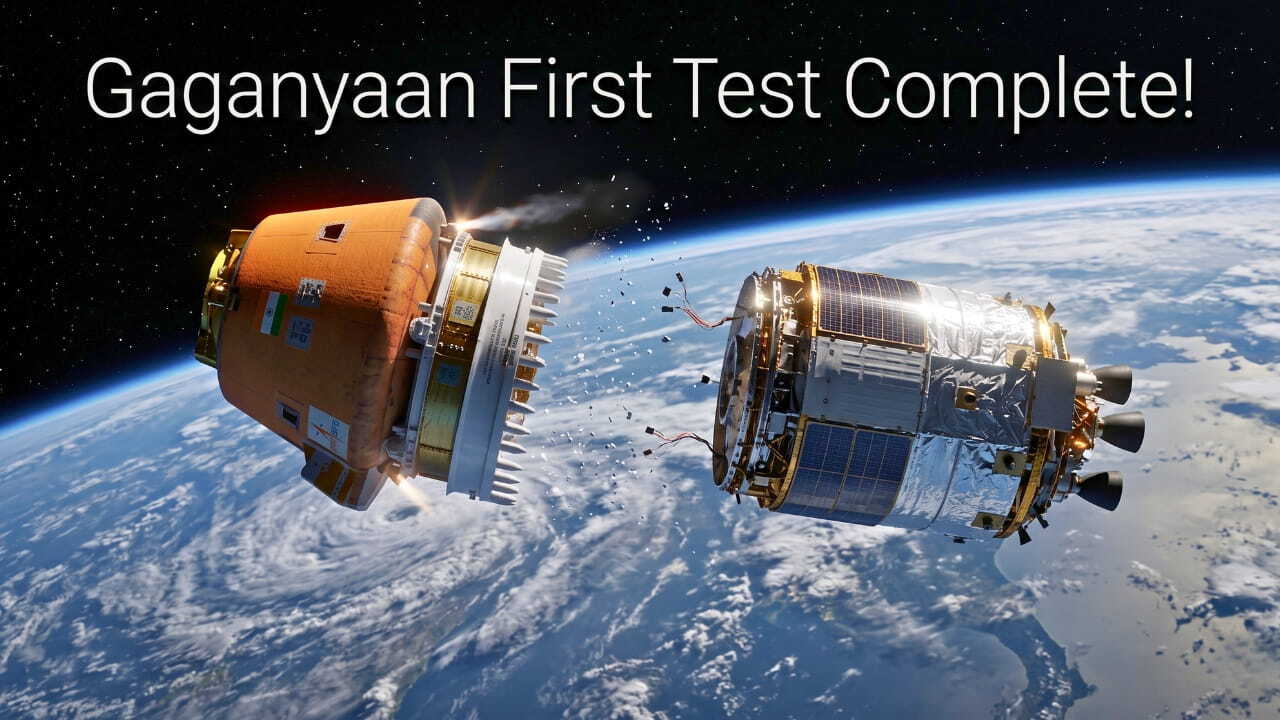

Preparations for India’s first human space mission, Gaganyaan, have intensified. The Indian Space Research Organisation (ISRO) has completed several key tests related to separating the Gaganyaan crew module from the service module. This test is crucial for mission safety. ISRO is now preparing for Gaganyaan’s first uncrewed flight in 2026.
Why is this test necessary?
Gaganyaan’s orbital module consists of two main components: the Crew Module (CM), which will accommodate astronauts, and the Service Module (SM), which provides essential services during the mission. When Gaganyaan is launched, the two modules will be connected and work together until reaching space.
There are connections between the two modules for power and other services. When the crew module is to be returned to Earth, these connections must be severed, and it must also be separated from the service module. This entire process is carried out according to a set procedure. During this process, several technology systems and separation devices work together. Any malfunction could hamper the crew module’s return. For this reason, ISRO tested the entire system.
Test conducted in Thiruvananthapuram
This ISRO test took place at the Vikram Sarabhai Space Centre in Thiruvananthapuram, Kerala. The crew module and service module were assembled to create a setup that simulated the processes that would occur during a real mission. The test also examined whether the various connections between the two modules were disconnected at the correct time. To this end, various instruments monitored the entire process.
These systems were also tested.
The shock generated during module separation should not affect the spacecraft’s vital equipment. Therefore, ISRO also tested the robustness of several key systems, including the avionics, the inertial navigation system, the heat shield, and the deployable umbilical shield.
Additionally, the crew module’s positioning system and the temperature and humidity control systems were also tested. The proper functioning of these systems is crucial because the crew module must maintain its course on its return to Earth and avoid the intense heat of atmospheric re-entry.
Preparations for an Unmanned Mission in 2026
Gaganyaan is India’s human space mission. It plans to send Indian astronauts into low Earth orbit and return them safely. ISRO will first test the spacecraft’s various systems and safety procedures through an uncrewed mission. This mission, named G1, is targeted for launch in 2026. Further preparations will be made based on the results obtained.