

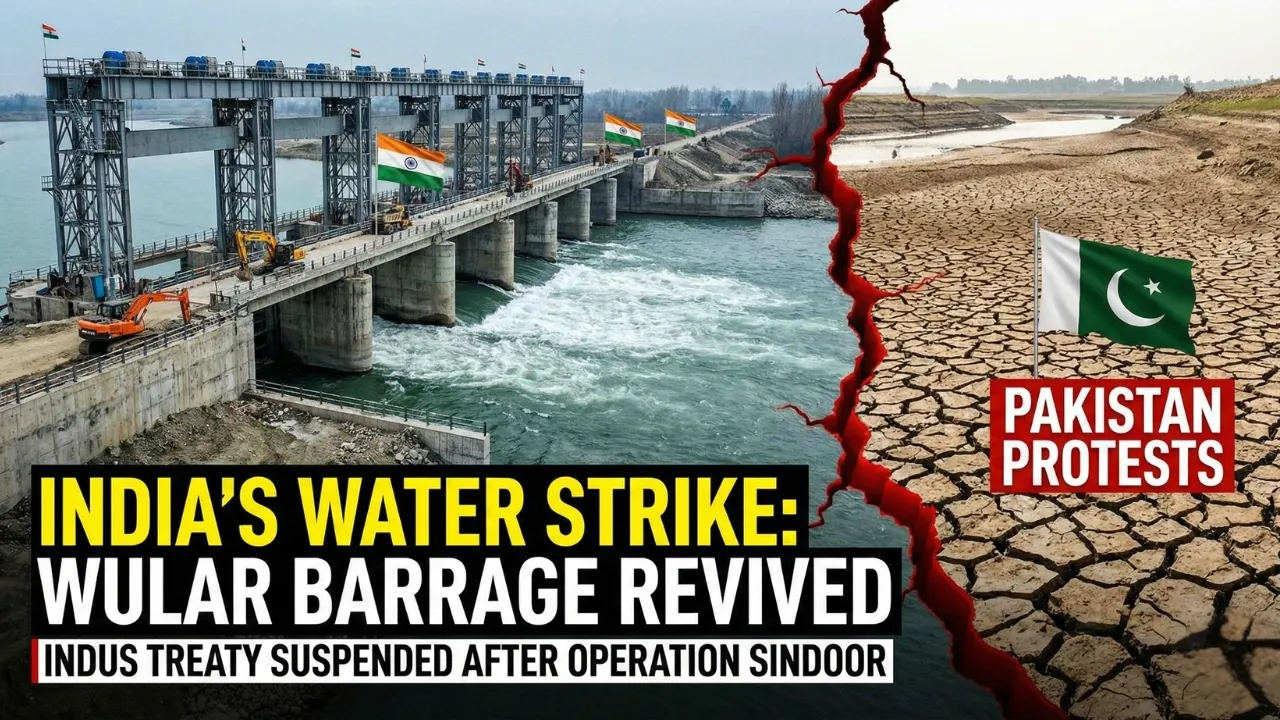

Following Operation Sindoor, relations between India and Pakistan reached a new low. India, which had been abiding by the Indus Water Treaty in the name of humanity, subsequently cancelled it. Pakistan debated the issue, but the central government made it clear that the treaty was for peacetime; if Pakistan did not want to establish peace, it would cease to exist.
In line with this, the Jammu and Kashmir government is reviving the Wular Barrage project, which had been suspended for four decades. Its purpose is to store and regulate water flow from the Jhelum River.
The Government of India and the Government of Jammu and Kashmir shelved this project in light of the Indus Water Treaty. Now that the treaty has been suspended, the Omar Abdullah-led local government is reviving it. According to officials, the central and state governments will soon begin work together.
What is the current status of the Wular Lake?
Following Operation Sindoor and the decision to suspend the Indus Water Treaty, the Wular Barrage Lake has once again come into public attention. Chief Minister Omar Abdullah stated in the Assembly that his government is working with the central government on two major projects: water supply to Jammu city from the Chenab River in Akhnoor, and the Tulbul Project (Wular Barrage) on the Jhelum. It is worth noting that this project was previously funded by the Asian Bank but was halted under the Indus Treaty.
As of today, the lake’s size varies according to the flow of the Jhelum River. Its minimum size is 20 square kilometres, while the maximum is approximately 190 square kilometres.
Residents also hope for increased employment with the construction of this barrage. According to an NDTV report, locals explained that the flow of the Jheelun River decreases in winter, leaving much of the Wular River dry. Now that the government is working on this project, it will improve their livelihoods. It’s worth noting that hundreds of people from Bandipora to Sopore have been using boats on this lake to fish, harvest water chestnuts, and lotus cucumbers. Still, the lake’s shrinking is eroding their traditional livelihoods.
Pakistan’s Response
Following India’s suspension of the Indus Water Treaty, Pakistan has been issuing frequent statements. Pakistan even warned that withholding water would be considered an act of war. However, India maintained its stand. The central and state governments are working together to begin work on this soon.