

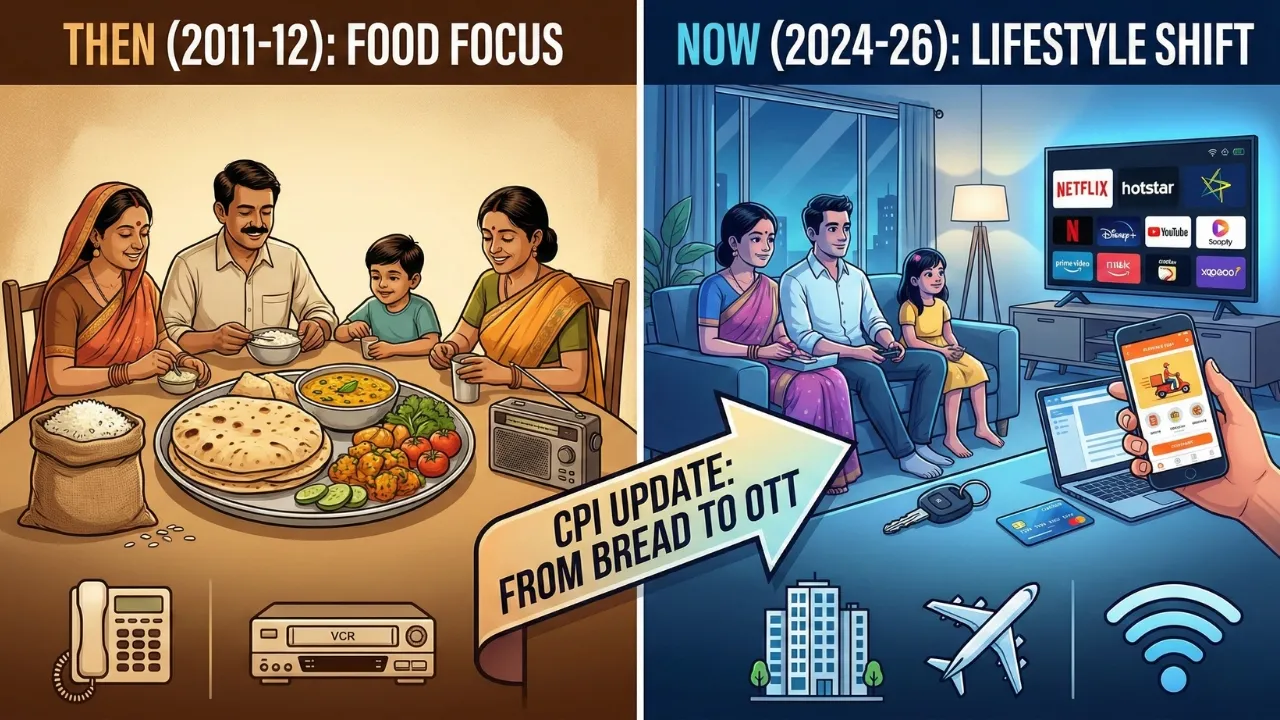
Times have changed, people have changed, and their lifestyles have changed. Yes, the standard of living in India is rapidly changing, which provides new insights into the country’s economy. The government recently updated its inflation index. The CPI update revealed that people are now spending more on services than on food. This means it’s no longer just about food. The country’s spending patterns are changing, and so has the index.
The latest Consumer Price Index (CPI) figures for January are not just new inflation numbers. Inflation, which reached 2.75%, has returned to the Reserve Bank’s target band. At first glance, this appears to be a routine statistical update that should already have occurred, as the previous basket was based on consumption patterns from 2011-12. But behind this technical change lies a story of major shifts in the economy.
The revision of the CPI basket not only modernises the method of measuring inflation but also reflects shifts in the pending priorities of Indian households over the past decade. The weightage of food items has decreased, whereas newer expenditures, such as services, housing, and OTT, have become more important. This shift from bread-and-butter to OTT indicates that the Indian economy is no longer limited to basic needs but is increasingly oriented toward diversified and discretionary consumption.
Why the CPI Basket Needed to Be Reset
To accurately measure inflation, it is essential to understand what people buy and how much they spend on each item. When spending patterns change, the index must also be revised. The previous CPI basket was based on spending patterns from 2011-12. At that time, digital services, organised retail, app-based transport, streaming platforms, and new fuels such as CNG and PNG had not yet become increasingly common.
The new series changes the base year to 2024 and incorporates new data sources, such as digital and government records. Rural housing rents have been included for the first time, and the housing sample size has been expanded in both rural and urban areas. Prices from e-commerce websites have also been added to the index. Items like OTT subscriptions, airfares, and telecom plans are now formally tracked. Older items like VCRs, cassette players, and coir ropes have been removed. These changes enhance data accuracy and reflect shifts in digital subscriptions and contemporary lifestyles.
Major Change in Food Structure
The most significant change in the new CPI is the reduction in the weight of food, which previously accounted for approximately 46% and is now approximately 37%. Food still accounts for the largest share of the CPI and, at 37%, has a significant impact on inflation, but the reduction is economically significant in its own right.
Food prices are often volatile, influenced by monsoons, supply constraints, and global commodity trends. The lower weighting means that fluctuations in headline inflation may be somewhat less pronounced. If the share of food consumption has decreased, it means that people are not eating less, but that other expenses are rising faster relative to income.
What do household expenditure data reveal?
According to the Household Consumption Expenditure Survey, the average monthly per capita expenditure (MPCE) in rural India increased from ₹1,430 in 2011-12 to ₹3,773 in 2022-23. In urban India, it increased from ₹2,630 to ₹6,459. This means that expenditures have more than doubled over the past decade.
In rural areas, the share of food expenditure decreased from 52.9% in 2011-12 to 46.38% in 2022-23. In urban areas, it decreased from 42.62% to 39.17%. This indicates that although both total income and expenditure have increased, the share of food consumption has been gradually decreasing. People are now spending more on clothing, transportation, housing, healthcare, education, and entertainment.
Increase in Service Expenditure
The new CPI basket includes items like rural housing, streaming services, digital devices, value-added dairy products, and babysitting. This reflects changes in lifestyles and needs. The inclusion of rural rent is significant because the trend of renting and buying homes has increased, even in rural areas.
The inclusion of online media subscriptions and digital services reflects India’s growing digital economy. Telecom plans, OTT platforms, and air travel are no longer limited to the wealthy; they have become part of the budgets of ordinary families. This shift indicates that the economy is moving from lower-middle-income to middle-income status. As incomes rise, families begin to spend not only on basic needs but also on convenience and experiences.
Food Still Matters
While the change is significant, it should not be exaggerated. Food still accounts for the largest share of inflation, at approximately 37%. In a country such as India, with a large rural population, food security and price stability remain major concerns.
The January 2026 CPI change shows that India’s spending patterns are changing. Household expenditure has increased significantly over the past 10 years, shifting its share from food to housing, services, and modern goods. While this change in CPI may seem technical, it clearly reflects India’s changing consumption story.