

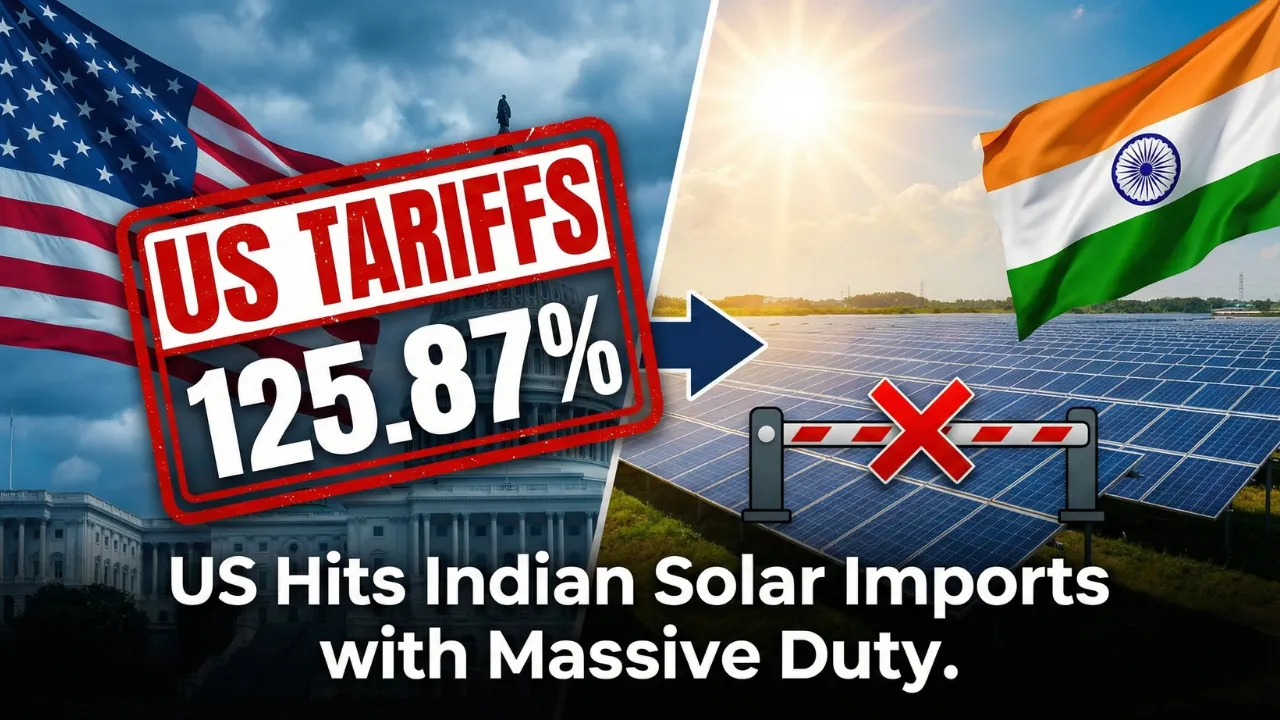
The US has announced a 125.87 percent tariff on imports of certain Indian solar products, accusing India of unfair subsidies. The US has also announced varying duty rates on crystalline silicon photovoltaic cells, whether assembled into modules or not, imported from Indonesia and Laos.
According to the US order, on February 24, 2026, the US Department of Commerce announced its preliminary findings in a countervailing duty investigation regarding crystalline silicon photovoltaic cells (solar cells), whether assembled into modules or not, from India, Indonesia, and the Lao People’s Democratic Republic (Laos). These duties are in addition to the 10 percent tariff announced by the US administration on all countries since February 24. According to the order, solar imports from India to the US increased from US$83.8 million in 2022 to US$792.6 million in 2024.
The world’s third-largest producer
The order stated that, unless postponed, final decisions in these countervailing duty (CVD) investigations will be issued on July 6, 2026. The Department of Commerce is also conducting a parallel anti-dumping duty investigation involving solar cells from India, Indonesia, and Laos. Tariffs help protect companies from subsidised imports.
India is taking several steps to promote renewable energy production and reduce its dependence on imports. Solar energy has emerged as a key sector in this area. India is currently the world’s third-largest solar energy producer. According to an official statement, India’s solar manufacturing sector includes key components such as solar modules, solar PV (photovoltaic) cells, ingots, and wafers. Producing these domestically supports the domestic economy and reduces dependence on imports.
The government introduced the PLI scheme.
To promote domestic manufacturing, the government has mandated the use of Indian-made panels and cells in projects under schemes such as the Rooftop Solar Program, the Pradhan Mantri Kisan Urja Suraksha evam Utthan Mahabhiyan (PM-KUSUM) scheme, and the CPSU Scheme (Phase II). To reduce imports, encourage local manufacturing, and reduce dependence on foreign suppliers, India imposed a basic customs duty on imported solar cells and modules in April 2022. Under the Production Linked Incentive (PLI) scheme for manufacturing high-capacity solar PV modules, contracts have been issued for setting up fully/partially integrated solar PV module manufacturing units with a capacity of approximately 48.3 GW in the country.
Imports also declined
Under this scheme, approximately 26.6 gigawatts of solar PV modules, 10.5 gigawatts of solar PV cells, and nearly two gigawatts of ingot-wafer manufacturing capacity have been established so far. Furthermore, 55 solar parks with a total capacity of 39,973 megawatts have been approved under the scheme. India’s imports of solar modules declined to US$2.15 billion in 2024-25 from US$ 4.35 billion in 2023-24. Imports from China also declined to $1.7 billion in the last fiscal year, from $2.85 billion in 2023-24. Other countries from which India imports include Vietnam, Hong Kong, Malaysia, and Singapore.