

The beautiful valleys of Uttarakhand are home to many hidden religious sites that few people know about. The Trinetreshwar and Ekadas Rudra Mahadev Temples near Almora are one such supernatural shrine.
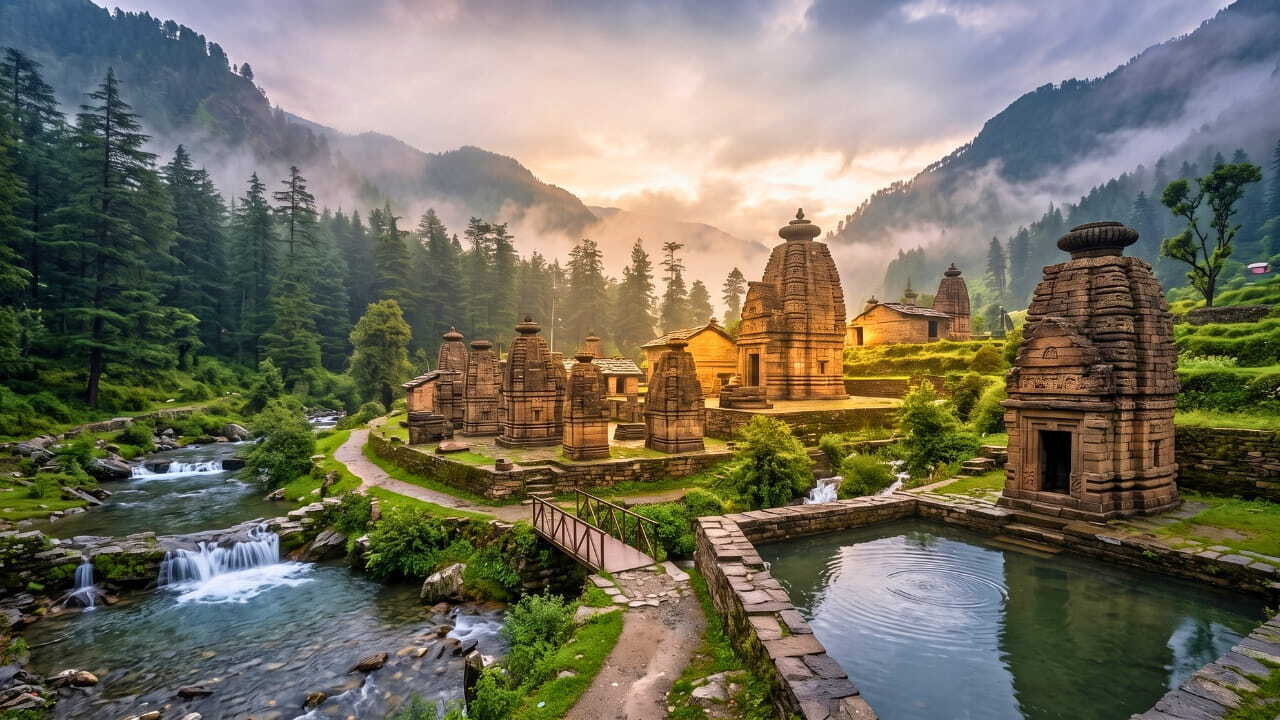
Locals call this sacred site the Trinetra Mahadev Temple. Nestled amidst mountains and greenery, this temple evokes a sense of peace.
The flowing Suyal River and small waterfalls further enhance the beauty of this place. In this article, we will explore the fascinating secrets of this ancient temple, dating back to the 9th-10th centuries.
16 Ancient Temples Built Without Mortar
The entire complex encompasses approximately 16 ancient Shiva temples. These temples were constructed between the 9th and 10th centuries. Their architecture resembles the famous Jageshwar Dham temples.
These temples are built by stacking carved stones one above the other. The special thing is that no mortar, such as lime or cement, was used to join them.
There is a small pedestrian bridge near the main temple complex. By crossing it, you can see several other beautiful and ancient temples.
History Revealed in Statues and Stones
For security reasons, many of the temple’s rare ancient statues and relics are kept in a small room. Visitors can also view them from the outside window. Specially carved stones from the upper parts of some temples have been installed on the floor below.
These stones contain Shivalingas, which devotees worship. Beautiful statues of Lord Vishnu, Suryadev, Lakshmi-Narayan, Kartikeya, and Uma-Mahesh are installed in the temples’ sanctum sanctorum. There were also statues of Jain Tirthankaras here, which are now preserved in the Almora Museum.
Water Levels Rise Before the Rains
Near the larger temples, there is a small temple dedicated to Lord Shiva and Sheshnag. Inside this small temple, there is a water tank. Locals believe that the water in this pond is directly connected to changes in the weather.
Whenever heavy rain is expected in the area, the pond’s water level rises a few days beforehand. This water acts as a warning for the people. People have deep faith in this natural sign.
During drought, rain comes through prayers.
Another unique belief is associated with this temple complex. Whenever this hilly region faces a prolonged drought or lack of rain, the villagers gather at this small temple.
Everyone together performs the Jalabhishek of Lord Shiva and Sheshnag here. Locals say that within two to three days of offering water, the sky becomes cloudy and heavy rains begin. This tradition is still observed with great devotion.
The water of Brahma Kund holds the cure for diseases
Right next to the temple is a huge rock in the middle of the Suyal River. Near this rock, the river water forms a small pond called Brahma Kund. Villagers firmly believe that the water in Brahma Kund possesses medicinal and divine properties.
Bathing in this pond is believed to relieve skin and body problems. In recent years, the entire temple complex has undergone renovations and maintenance, but the ancient architecture still retains its original charm.