

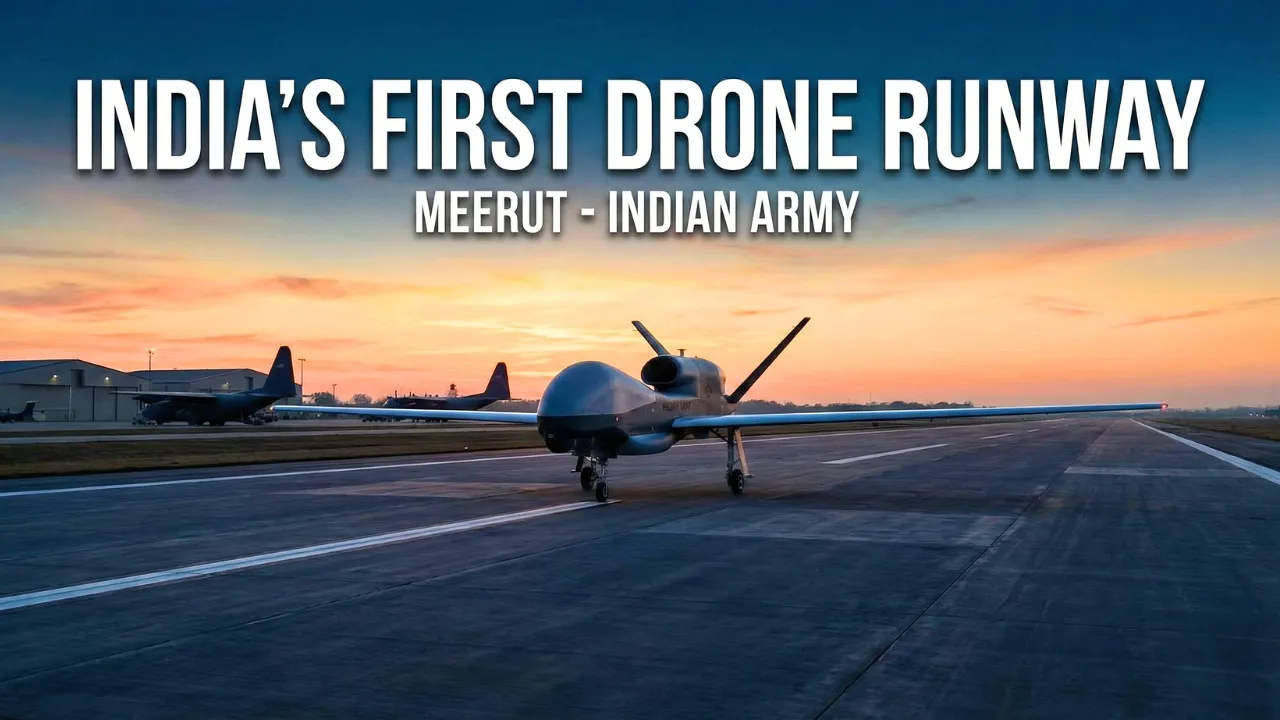
Following Operation Sindoor, India continues to adapt its military to modern warfare. The Indian Army is building its first dedicated runway for drones and remotely piloted aircraft (RPA) in Meerut. This base will span over 900 acres. The BRO, under the Ministry of Defence, has begun construction of a base for high-altitude, long-endurance (HALE) drones.
What will the first drone runway look like?
According to a News18 report, the BRO has invited bids for project management consultancy services for this ₹406 crore project. The central runway at the base will be 2,110 meters long and 45 meters wide, enabling operations of remotely piloted aircraft (RPA) and C-295 and C-130 transport aircraft. Two 60-meter-wide and 50-meter-long hangars will also be constructed at the base to accommodate aircraft and drones.
What are the features of the runway?
The runway will be equipped with lighting and modern navigation equipment compliant with ICAO CAT-II standards, enabling operations even in low-visibility conditions. Around 1,500 RPA operations are expected from here, along with heavy aircraft movements. This equates to approximately 4 drone flights per day. The base is being designed to be more than just an airstrip; it will also serve as a strategic hub for the troops operating from here.
When will construction be completed?
According to reports, the Army has set an 85-month deadline to complete the base’s construction. Of this, 7 months have been allocated for pre-contract planning and preparation of the detailed project report (DPR). Following this, 18 months are dedicated to construction work. An additional 24 months are allocated to defect liability, and the remaining 36 months to maintenance and monitoring.
Why did the Army take this step?
This project began as drones became increasingly important in military operations. Drones were also used extensively by Pakistan during Operation Sindoor. However, India’s anti-drone systems shot down most of them. The lessons learned from this operation have further reinforced the importance of infrastructure for uncrewed missions.