
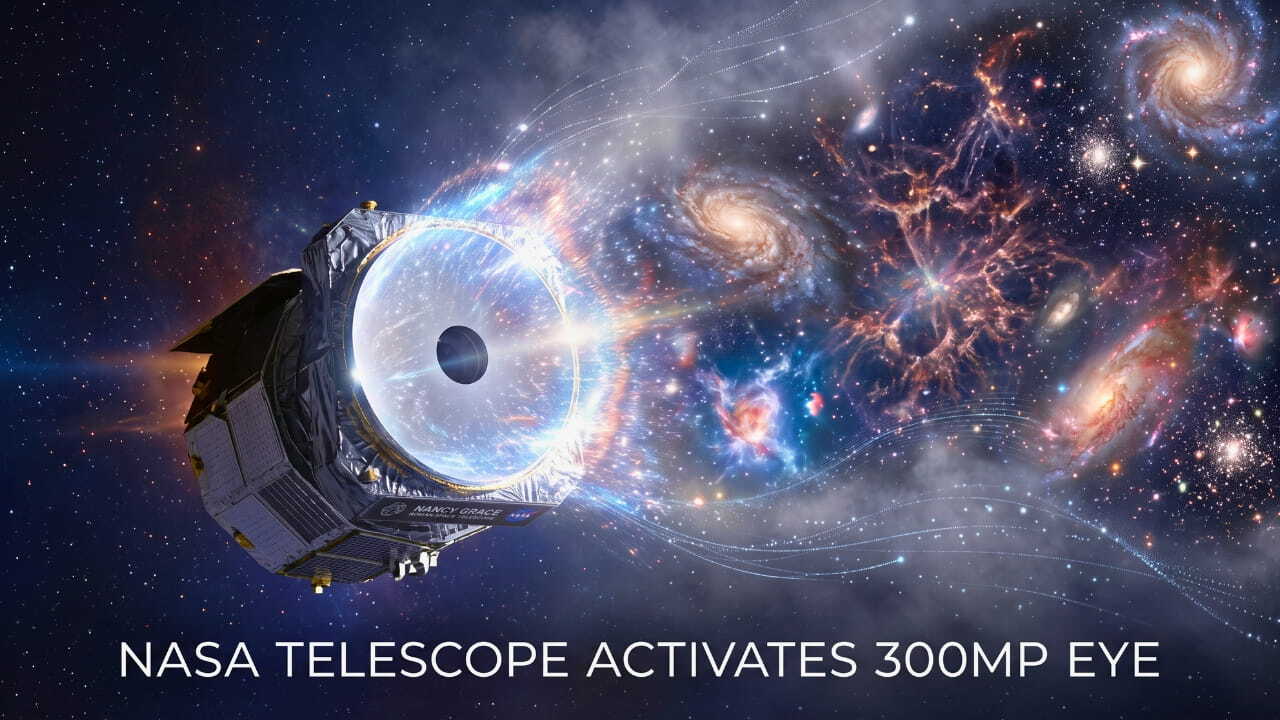

NASA has taken another step toward unravelling the mysteries of space. Have you ever dreamed of capturing images so clear and detailed that every corner of the universe could be clearly visible on your screen? NASA has now achieved just that.
NASA has unleashed the massive 300-megapixel eye of its most advanced and powerful space telescope into space. It’s not just a camera, but a tool for exploring the history of the universe, dark matter, dark energy, and life on other planets, a tool poised to disrupt the world of science.
NASA’s Nancy Grace Roman Space Telescope has unleashed its massive 300-megapixel eye into space. NASA has successfully activated its primary science instrument, the Wide Field Instrument. This is a massive infrared camera and the Roman telescope’s scientific instrument. It will enable scientists to research vast swaths of space.
Meanwhile, engineers have also completed preliminary testing of another crucial component, the coronagraph. This instrument will help capture images of planets around other stars. The Roman Telescope is currently en route to its new space station.
Roman will reach a distance of approximately 1.5 million kilometres
The Roman Telescope is currently on a three-month journey. It aims to reach the second Sun-Earth Lagrange point (L2), located between the Sun and Earth. This point is approximately 1.5 million kilometres from Earth. From here, the telescope will have a clear, unobstructed view of space.
Why is the Roman Telescope special?
The telescope’s wide-field camera can capture an image larger than the Moon in a single shot. This telescope will cover an area at least 100 times larger than that of the Hubble Space Telescope and survey the sky 1,000 times faster. Using infrared light, it will research dark energy, dark matter, and the formation of galaxies. It will also help discover new planets outside our solar system.
According to NASA, the telescope’s first scientific images are expected in early 2027. Calibration and testing will continue over the next few months, after which it will begin to unravel the universe’s untold mysteries. So, if you’re interested in the world of space, stars, galaxies, and the search for alien life or new worlds on other planets, the images resulting from this NASA effort may surprise you.