

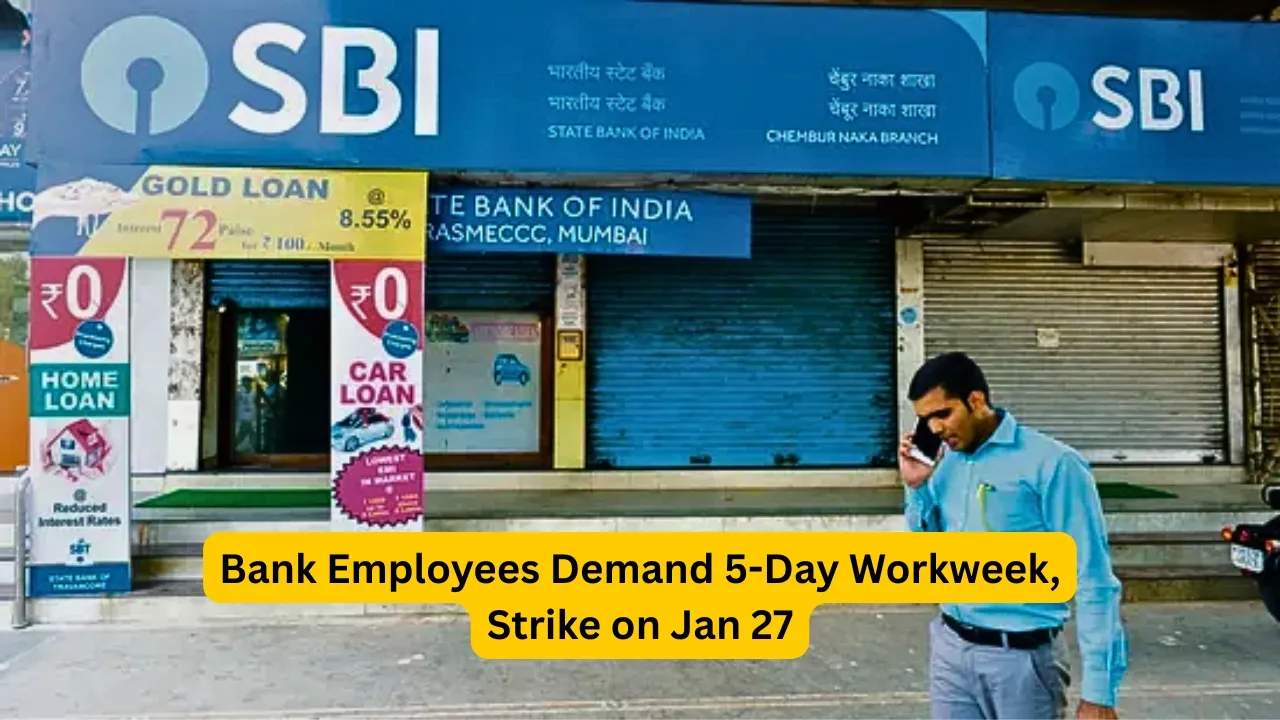
If you’re planning to visit your bank on January 27th, first check whether it’s closed on Tuesday. Bank employees’ unions have announced a nationwide strike on January 27 to press for their long-pending demand for a five-day workweek. The United Forum of Bank Unions (UFBU) has called this strike. Consequently, banking services across the country are expected to be affected.
The unions’ main demand is that banks also implement a five-day work week with two days off. The UFBU says that, under the wage revision agreement with the Indian Banks’ Association (IBA) in March 2024, all Saturdays were to be made holidays, but this has not yet been implemented. Bank employees are going on strike to protest this delay.
Currently, bank employees only get holidays on the second and fourth Saturdays of each month. Banks are open on other Saturdays, forcing employees to work 6 days in 2 weeks a month. Unions say this arrangement is no longer appropriate over time.
The strike will involve all major public sector banks across the country, including State Bank of India (SBI), Punjab National Bank (PNB), Bank of Baroda, Bank of India, Canara Bank, Indian Bank, and other public sector banks. Bank employees have already begun demonstrations in several cities and have warned that the movement will intensify if their demands are not met.
Bank unions have clarified that implementing the five-day work schedule will not reduce working hours. They say employees are willing to work approximately 40 minutes extra each day, Monday to Friday, without reducing total weekly working hours. This proposal has been submitted to the government, but no final decision has been made for the past two years.
Stocks may rise on tariff hints, EU deal hopes, and RBI liquidity
The Indian stock market’s key indices, the Sensex and Nifty 50, are expected to see some recovery this holiday-shortened week, driven by hopes of US tariff relief and the possibility of progress on the India-European Union (EU) trade deal.
The Indian stock market is closed on Monday, January 26, on account of Republic Day 2026. Trading on the BSE and NSE will resume on Tuesday.
The stock market saw a sharp decline last Friday due to continued selling by foreign investors, global tensions, caution ahead of the Union Budget, and mixed December-quarter results. However, some important developments over the weekend could improve the market sentiment.
US Treasury Secretary Scott Bessent has hinted that the additional 25 percent tariff imposed on India may be withdrawn. He noted that India has significantly reduced its purchases of Russian oil since the tariffs were imposed. This could provide support to the Indian stock market.
Meanwhile, European leaders have arrived in India for the 16th India-EU Summit. The meeting will discuss advancing a Free Trade Agreement (FTA) to strengthen trade between the two sides.
Experts believe that this agreement can help India better connect with global markets, increase exports, and create new supply chains.
Experts say that by fiscal year 2025, 17.3 percent of India’s total exports and 8.4 percent of its imports will be linked to the EU. They estimate that this agreement could increase India’s exports by $50 billion by 2031.
He said this would increase foreign investment (FDI), facilitate technology exchange, and benefit IT services exports. Experts believe the market is likely to respond positively to this agreement. However, a successful India-US agreement, rupee stability, and a calmer global climate are also essential.
Gold prices cross $5,000 an ounce amid global uncertainty
Amid rising uncertainty and tensions worldwide, gold prices have surged sharply, surpassing $5,000 per ounce and setting a new record.
Safe-haven precious metal gold rose to $5,026 an ounce during trading, while silver rose above $102 an ounce for the first time. In January 2024, gold prices were slightly above $2,000 an ounce.
Experts say that as we move into 2026, precious metals, i.e., gold and silver, are trading in a strong bull market, and despite some slight decline in between, their upward momentum is intact.
According to analysts, the current situation is not one of weakness but of price stability. Long-term strengths outweigh short-term fluctuations.
Ponmudi R., CEO of the online trading and wealthtech firm Enrich Money, said safe-haven demand, continued central bank gold purchases, and expectations of global monetary policy easing are supporting prices. He added that previously resistance levels are now seeing strong demand, further strengthening the market.
Silver has outperformed gold during this rally. Comex silver has surpassed $100, reaching a new record high. Market experts say silver’s unique advantage lies in its dual use for investment and industrial purposes. This is why silver demand is showing strong.
According to experts, this rally is not driven by rumours or speculation, but by strong economic factors. The future for gold and silver remains strong, especially in the first quarter of 2026 and beyond.